
Why the Disappearance of Cash Worries Citizens
Author: Xinning Wang
September 29, 2026

With most economies building up their digital payment infrastructure and capacity, a cashless society is becoming an imminent reality. By one definition, a cashless society in the true sense should be understood as a society in which all central bank-issued coins and notes are removed from circulation (De Grauwe & Costa Storti, 2002). Money held by individuals now takes the form of deposits created by financial institutions, including banks and other firms (De Grauwe & Costa Storti, 2002).
According to this definition, money is fundamentally dematerialized and represented as claims on banks or other financial institutions that issue deposits in a cashless society. Meanwhile, with the involvement of different private financial intermediaries in digital payments, which are the main payment measure in a cashless society, the traditional boundaries among governments, financial institutions, and consumers become blurred (Arvidsson, 2019). The newly established dynamics between all stakeholders in a cashless society bring about a redistribution of power and affect different groups in varying ways. Benefits tend to favor governments and involved institutions, while citizens are more likely to bear the risks of an unequal redistribution of power (Achord et al., 2018).
Thus, a cashless society generates significant concerns regarding its implications for citizens, ranging from losing property rights, increased risk aversion, information access, and digital privacy.Particularly, the deprivation of individual ownership of cash, or the property rights over money, weakens an individual’s capability to cope with infrastructure-related risks as it eliminates cash as a final fallback during infrastructure failures (De Almeida et al., 2018). Moreover, eliminating cash might lead to individuals’ overreaction towards existing risks (Ericson & Fuster, 2013). In addition, privacy concerns represent a difficult-to-quantify cost for consumers, potentially offsetting the perceived efficiency gains of digital payments, given the extensive involvement of private firms in data collection and processing (Knümann et al., 2024). The data collection phenomenon will further lead to information asymmetry between consumers and merchants, eroding customers’ ability to bargain and make rational decisions (Brunnermeier and Payne, 2025).
From a legal and economic perspective, the transition from property rights in cash to creditor claims increases individuals’ reliance on financial institutions and reduces their ability to cope with disruptions caused by infrastructure failures. As illustrated in Laurinavičius (2006), once the individual, who holds cash as property, transfers or deposits their money to the bank, the latter will normally acquire the ownership of the property, and the individual becomes the owner of the claim. In this way, the individual only holds direct property rights when they hold cash to conduct transactions. In contrast, in a cashless society, where there is no cash, all the money ownership (i.e., the individual’s property rights), becomes the creditor’s claims against the bank. As a result, their access to funds and property needs third-party intermediaries, including banks and possibly private firms. This change will, firstly, significantly increase individuals’ dependence on financial institutions, especially during periods of infrastructural failure when access to money and payment systems may be disrupted. One prominent example is the 2025 Iberian Peninsula blackout, which was one of the largest power outages in the recent history of Spain and Portugal. During this blackout, cash withdrawals were severely affected as most ATMs did not have alternative power sources. Digital payment systems were also disrupted. Thus, non-cash payments declined sharply, particularly in terms of consumption and retail operations (Cremades, Esandi, & Pérez, 2025). The European Central Bank (2025) pointed out that cash serves as an effective tool to act against infrastructure failure and so mitigates infrastructure dependency risks. Thus, removing all cash to create a cashless society removes an instrument for citizens to hedge against systemic infrastructural risks.
Secondly, the endowment effect in behavioral economics, (i.e., the tendency for individuals to value an item more simply because they own it), will bring an aversion to risk and a valuation distortion. Aragón, Molina, and Outes-León (2020) argue that the loss of property rights could enhance the level of risk aversion: their empirical study found that granting property rights to citizens could significantly reduce risk aversion, decreasing the proportion of highly risk-averse individuals by nearly ten percentage points (from approximately 73 percent of the sample), which corresponds to a 13 percent increase in risk tolerance relative to the mean. This indicates that stronger and more secure ownership structures, such as owning cash, tend to increase individuals’ willingness to bear risk.
Hence, citizens who have long held physical money may perceive it as a form of ownership. Once this is replaced by intangible, account-based claims, their evaluation of both existing risks and risks associated with digital payments, for example, infrastructure risks and cybersecurity risks, will be distorted. Such cognitive bias will lead to an overreaction to risks, further impairing an individual's capability to effectively manage potential risks in a cashless society. Therefore, losing cash is not merely losing a way of payment, a responsive tool against infrastructure failure risks, but can also deepen citizens’ fear of risks and eventually lead to an overreaction to risks.
Overall, this dual impact, driven by the loss of property rights, reduces individuals’ financial resilience by limiting their coping mechanisms and distorting their perception of risk.
Regardless, cashless payments are widely regarded as cost-efficient, as they eliminate expenses associated with physical currency—including currency production, ATM infrastructure, cash-in-transit services, and counterfeit prevention—while also reducing the time needed for transactions. However, the costs of these different payment methods for consumers are difficult to determine. Knümann et al. (2024) conducted a survey questioning the costs of using various means of payment. According to this survey, cash incurs the lowest cost per transaction to consumers, though when costs are evaluated as a proportion of the transaction value, digital payments (ie., debit card transactions) tend to be more cost-effective than cash. However, many consumers are reluctant to abandon cash for digital payment methods because they are perceived as similarly efficient in everyday transactions. Furthermore, one of the highest hidden costs for consumers in a cashless society is the loss of privacy, which is difficult to quantify and evaluate. As a result, the modest cost savings associated with digital payments may be outweighed by privacy concerns (Zuboff, 2019).
Apparently, digital payments have a positive impact on tax collection, making tax compliance and revenue collection more efficient and transparent for the public sector (Celestin, 2019). However, from the market’s point of view, this data collection in a cashless society, compounded by technological improvements, will lead to a high asymmetry of information between consumers and merchants. While merchants can collect and analyze vast amounts of transaction data, including consumers’ payment habits, purchasing behavior, and inferred wealth levels (due to digital payment options and algorithmic programming), there are no equivalent tools available for consumers to obtain comparable information about merchants; this creates heightened asymmetry within the market (Brunnermeier & Payne, 2025).
According to Akerlof (1970), the information asymmetry problem will highly hinder the consumer’s ability in terms of bargaining power, as consumers do not know the seller’s reservation price or cost structure due to a lack of information. This was shown in a 2025 study by the U.S. Federal Trade Commission, which found that retailers can apply personalized prices from a collection and analysis of consumers’ data. At the same time, Davida (2024) indicated that as the traders in the market take advantage of the collected data to create targeted advertising, manipulative personalization, and other personalized persuasion practices targeting consumers in which the individuals’ autonomy in decision-making is also limited. These side effects will ultimately undermine the equitable distribution of market power between consumers and merchants.
On the other hand, with the increasing involvement of Big Tech in providing new digital payment platforms for customers, the non-bank players have grown significantly in the share of the market. According to the Bank for International Settlements, companies including Amazon, Apple, and Meta have entered payment markets by leveraging their existing user networks and data assets, using payment services as a gateway to broader financial services (Cornelli et al., 2023). Meanwhile, in 2023, the global payments industry handled 3.4 trillion transactions, equivalent to 35 percent of total global banking revenues, growing at 7 percent annually from 2018 to 2023, as illustrated in Figure 1 (McKinsey & Company, 2024).
Figure 1. Global Payment Revenue, 2013-28 Forecast in Trillions of $
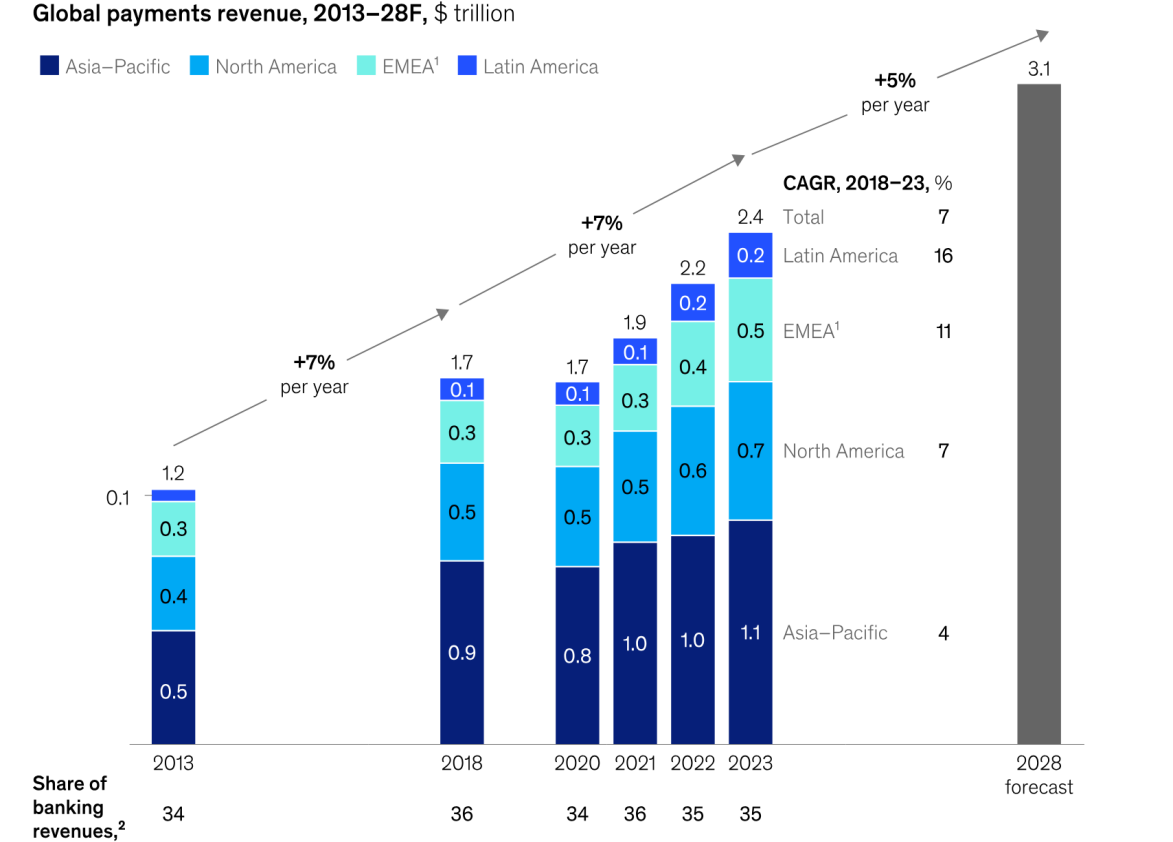
Note. From "Global payments in 2024: Simpler interfaces, complex reality," by P. Bruno, U. Jeenah, A. Gandhi, and I. Gancho, 2024, McKinsey & Company (https://www.mckinsey.com/ industries/financial-services/our-insights/global-payments-in-2024-simpler-interfaces-complex-reality). Copyright 2024 by McKinsey & Company.
The involvement of private firms in daily transactions will, however, alter the public goods characteristic of money by introducing private intermediation in access to payment services. According to the U.S. Department of Justice (2024), more than 60 percent of debit transactions in the United States were made on Visa’s debit network, allowing it to charge over $7 billion in fees each year for processing those transactions. This degree of dominance in the market yields to the abuse of power: Visa has been alleged to impose exclusionary agreements on its customers that discourage or penalize the switching of transactions to competing debit networks or alternative payment systems. By locking consumers into a single private network, payment access becomes excludable and will also contribute to heightened dependence on dominant private providers and a higher concentration of market power for certain companies (Alford, 2024). This stands in direct contrast to cash, which has traditionally functioned as a non-excludable public good that requires no private authorization to use.
Collectively, it is evident that a cashless society offers certain benefits, including transaction cost savings and greater data transparency for the public sector in conducting tax evaluations. Nonetheless, the consolidation of financial assets under banks and institutions concentrates power at the expense of individuals. In the context of law and economics, citizens are deprived of physical cash, ownership of money, and property rights—a loss that, as behavioral economics suggests, triggers loss aversion and overestimation of risk. Furthermore, pervasive data collection violates privacy while simultaneously impairing consumers’ bargaining power and rational decision-making ability. Therefore, the burdens of a cashless transition would fall disproportionately on individuals who are vulnerable groups within society, and their fear of the consequences brought by a cashless society should be mitigated by relevant measures from the governments and the institutions that stand to benefit from this transition.
Achord, S., Chan, J., Collier, I., & Nardani, S. (2018). A cashless society: Benefits, risks, and issues. British Actuarial Journal, 23, 1–16. https://doi.org/10.1017/S1357321718000223
Akerlof, G. A. (1970). The market for "lemons": Quality uncertainty and the market mechanism. Quarterly Journal of Economics, 84(3), 488–500. https://doi.org/10.2307/1879431
Alford, R. P. (2024, November 19). Breaking the Visa-Mastercard duopoly: Bringing competition and lower fees to the credit card system [Testimony before the U.S. Senate Committee on the Judiciary]. United States Senate Committee on the Judiciary. https://www.judiciary.senate.gov/imo/media/doc/2024-11-19_-_testimony_-_alford.pdf
Aragón, F. M., Molina, O., & Outes-León, I. W. (2020). Property rights and risk aversion: Evidence from a titling program. World Development, 134, 105020. https://doi.org/10.1016/j.worlddev.2020.105020
Arvidsson, N. (2019). The story of cash and the route toward a cashless society: The case of Sweden. In Building a cashless society (pp. 27–39). Springer. https://doi.org/10.1007/978-3-030-10689-8_4
Bruno, P., Jeenah, U., Gandhi, A., & Gancho, I. (2024, October 18). Global payments in 2024: Simpler interfaces, complex reality. McKinsey & Company. https://www.mckinsey.com/industries/financial-services/our-insights/global-payments-in-2024-simpler-interfaces-complex-reality
Brunnermeier, M. K., & Payne, J. (2025). Big techs, credit, and digital money (BIS Working Paper No. 1306). Bank for International Settlements. https://www.bis.org/publ/work1306.pdf
Celestin, M. (2019). The future of taxation in a cashless society: How digital payments and mobile money are changing tax collection. Brainae Journal of Business, Sciences and Technology, 3(6), 766–776. https://doi.org/10.5281/zenodo.15055110
Cornelli, G., Doerr, S., Leonardo, G., & Gambacorta, L. (2023). Big techs in finance (BIS Working Paper No. 1129). Bank for International Settlements. https://www.bis.org/publ/work1129.pdf
Cremades, L., Esandi, Á., & Pérez, M. (2025). The impact of the 28 April 2025 blackout on Spain’s payment systems. Financial Stability Review, 49. https://doi.org/10.53479/42425
Davida, Z. (2024). Consumer decision-making autonomy in the digital environment: Towards a new understanding of national courts’ obligation to assess ex officio violations of fair commercial practices. European Journal of Risk Regulation, 1–16. https://doi.org/10.1017/err.2024.11
De Almeida, P., Fazendeiro, P., & Inácio, P. R. M. (2018). Societal risks of the end of physical cash. Futures, 104, 47–60. https://doi.org/10.1016/j.futures.2018.07.004
De Grauwe, P., & Costa Storti, C. (2002). Monetary policy in a cashless society. In M. Balling, F. Lierman, & A. Mullineux (Eds.), Technology and finance: Challenges for financial markets, business strategies and policy makers (pp. 241–243). Routledge.
Ericson, K. M. M., & Fuster, A. (2013). The endowment effect (NBER Working Paper No. 19384). National Bureau of Economic Research. https://doi.org/10.3386/w19384
European Central Bank. (2025, September 25). Economic Bulletin Issue 6, 2025. https://www.ecb.europa.eu/press/economic-bulletin/html/eb202506.en.html
Federal Trade Commission. (2025). FTC surveillance pricing study indicates wide range of personal data used to set individualized consumer prices. https://www.ftc.gov/news-events/news/press-releases/2025/01/ftc-surveillance-pricing-study-indicates-wide-range-personal-data-used-set-individualized-consumer-prices
Financial Stability Board. (2019). BigTech in finance: Market developments and potential financial stability implications. https://www.fsb.org/uploads/P091219-1.pdf
Knümann, F., Krueger, M., & Seitz, F. (2025). Costs and benefits of cash and cashless payment instruments. Module 3: Costs of cash and card payments from a consumer perspective. Deutsche Bundesbank.
Laurinavičius, K. (2006). The legal nature of bank deposits. Review of Central and East European Law, 31(3), 291–330. https://doi.org/10.1163/157303506x129413
U.S. Department of Justice. (2024, September 24). Justice Department sues Visa for monopolizing debit markets. https://www.justice.gov/archives/opa/pr/justice-department-sues-visa-monopolizing-debit-markets
Zuboff, S. (2019). The age of surveillance capitalism: The fight for a human future at the new frontier of power. PublicAffairs.

(for college and high school students)
Staff Writer Leader:SpencerCopyright © 2023 The Global Horizon 沪ICP备14003514号-6