
Antarctic Sheet Viruses: An Ignored Threat to Global Public Health
Author: Ranqi Xiong
April 09, 2026
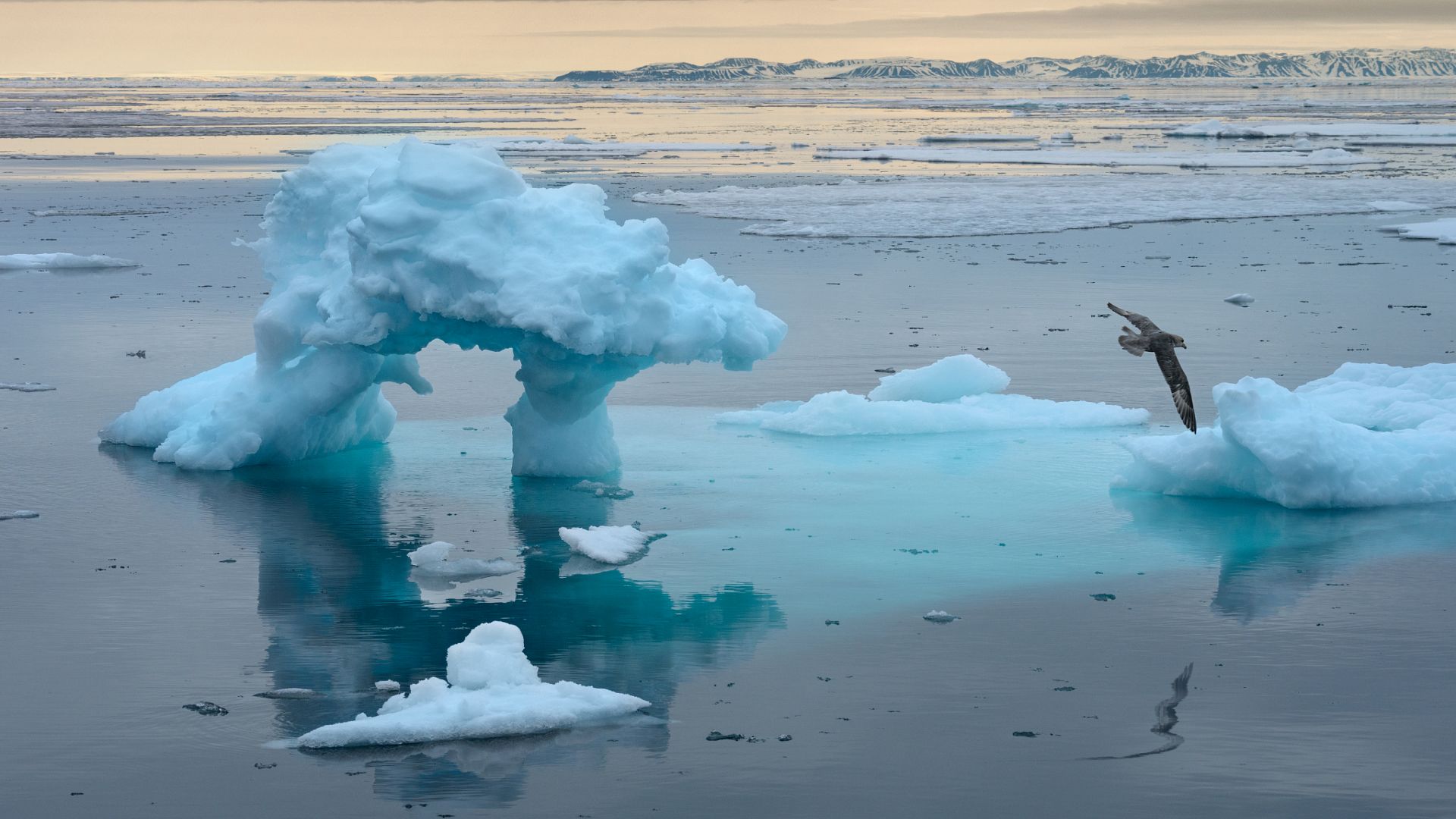
As people become more aware of rising greenhouse gas emissions and animal habitat loss caused by global warming, another serious issue is overlooked: the release of unknown pathogens hidden within the Antarctic’s melting ice core. The Ross Ice Shelf (RIS) is Antarctica’s largest ice shelf. Located in west Antarctica, the RIS makes up about 30 percent of the continent’s total ice shelf area, and is about as large as the country of France. Crucially, it acts as a “key regulator” of local and regional marine life, and global carbon and nutrient cycles.
Although one 2024 scientific publication noted that the RIS’ average melting rate is relatively low and stable compared to other ice sheets, there are approximately 607 novel viruses within its base that still poorly understood. So far, it is known that these viruses can increase their hosts’ freezing tolerance and take advantage of the air-sea interface, where the atmosphere interacts with the ocean surface and facilitates the exchange of gases, heat, and energy, and animals, to spread rapidly. Since there is no herd immunity against these viruses, the consequences may be dangerously unpredictable.
Yet despite researchers raising several alarms about the growing risks of novel Antarctic viruses to global public health, the two legal structures most equipped to address this problem have significant structural limitations: the Antarctic Treaty System (ATS) and the WHO’s International Health Regulations (IHR). Each should have their respective early warning mechanisms and global collaborations strengthened to increase preparedness against the inevitable spread of arctic viruses.
Antarctic Treaty System and Tourism
In 1959, the ATS was signed by twelve countries “for the purpose of regulating relations among states in the Antarctic,” ensuring that the continent was “used for peaceful purposes only” and that no country could make a territorial claim to the land. Since then, the membership has grown to a total of 58 states, all of which are expected to exchange information about their scientific, environmental, or other non-governmental activities in the Arctic. Despite its longstanding reputation, the ATS has not been effective in stopping the rapidly expanding tourism sector.
Antarctic tourist numbers has increased tenfold between 1992-2020, and there were 36,789 cruise ship-goers and 80,434 landed visitors from 2024-2025 alone. The long-distance flights many have to take to get to continent has resulted in a significantly higher aviation emissions for Antarctic tourism (ca 2.26 tons of CO2-eq per capita) than global tourism. Furthermore, researchers have confirmed that besides space tourism, Antarctic tourism is one of the most energy-intensive segments of the tourist market. The International Union for Conservation of Nature (IUCN) warns that this uptick in human activity risks the Antarctica’s ability to “regulate the global climate.” Although many tourist companies claim to promote public awareness of natural conservation work, their contributions to the RIS melting is undeniable.
Currently, there are no clear regulations promulgated by the ATS members to control the unregulated expansion of Antarctic land and sea expeditions. The ATS runs on a consensus-based decision making process, which makes it hard to agree on a unified policy stance in a timely manner, given that several members hold differing opinions on the industry. Additionally, past proposals have been frequently blocked through vetoing powers, which are granted to everyone. Instead of taking proactive measures, the ATS “largely relies on the industry to self-regulate.” Thus, the RIS is threatened by the unregulated development of the tourism industry, which is a prime example of cumulative impacts in the field of environmental protection.
International Health Regulations
On the other hand, the IHR is another policy framework that focuses on “addressing serious public health threats” that are not limited by state borders, such as the spread of Antarctic viruses, and legally requires its members to detect and notify the WHO of new infectious concerns.
However, the IHR lacks strict enforcement. Historically, governments have concealed outbreaks in order to prevent other states from imposing trade and travel restrictions. For example, when the WHO invoked the IHR to declare the COVID-19 a public health emergency in 2020, many countries did not comply for economic reasons or even refused to report their additional health protocols.
Similarly, other countries like China prioritized short-term socioeconomic interests over the long-term strategic management of global viruses during the 2003 SARS-CoV-1 outbreak. Such actions came after the WHO emphasizing that infectious disease prevention would be significantly cheaper than allowing outbreaks to go proliferate through continued tourist activities. The IHR, however, fails to restrain this kind of behavior.
Furthermore, most countries lack the capacity to detect new infections early, find solutions, and report them time. Even with known and existing cases, it is difficult to manage and report them following the process, especially when governments prioritize economic concerns—such as potential investment losses—over public health.
In the case of Antarctic viruses, the WHO’s IHR framework is unequipped to properly address the problem.
Possible Solutions
It is important for the ATS and IHR to incorporate stronger enforcement compliance mechanisms and periodic review processes to ensure enforcement and adaptivity.
As one of the most successful products of international consensus, the Montreal Protocol on Substances that Deplete the Ozone Layer set a good example on how cooperative global commons management can become more palpable. The Protocol governs the usage of various chemicals known as ozone depleting substances (ODSs), such as chlorofluorocarbons (CFCs) and hydrochlorofluorocarbons (HCFCs). Member states are expected to phase out ODSs with alternatives in an incredibly short time period of three years. The reason behind its relative success lies in its regular assessments and gradual target adjustments.
The Protocol’s previous successes provide some guidance on how to modify the ATS to improve their assessments and targets, and IHR to provide funding support. While the ATS does include mechanisms for periodic target adjustments, the countries’ vetoing powers hinders their effectivene implementation. This happened during one meeting where some voted to prohibit most oil discharges. The ATS can ban the mechanism that every country has the veto power. This can lead to wiser and efficient decision making to regulate Antarctic tourism.
Furthermore, the Protocol’s Multilateral Fund (MLF) provides financial and technical help to developing countries. For instance, under the help of MLF, India’s foam sector achieve huge process in phasing out the consumption of HCFCs. Since the WHO’s Independent Panel argued that countries with low- or middle-income need financial support for pandemic preparedness, providing countries with economic relief can result in higher compliance rates with IHR provisions.
Conclusion
The global community is facing the implicit threat from Antarctic viruses living under the Antarctic ice sheet, which is an important global commons. Even though several challenges remain, the problem can be relieved by modifying the ATS and the IHR. Inserting legal binds, limiting the veto power, and periodically updating the policy could effectively improve governance. However, there is still a long road that we need to pass in order to optimize the regulations, as the obstacles like competing national interests need hard tries to overcome.

(for college and high school students)
Staff Writer Leader:SpencerCopyright © 2023 The Global Horizon 沪ICP备14003514号-6