
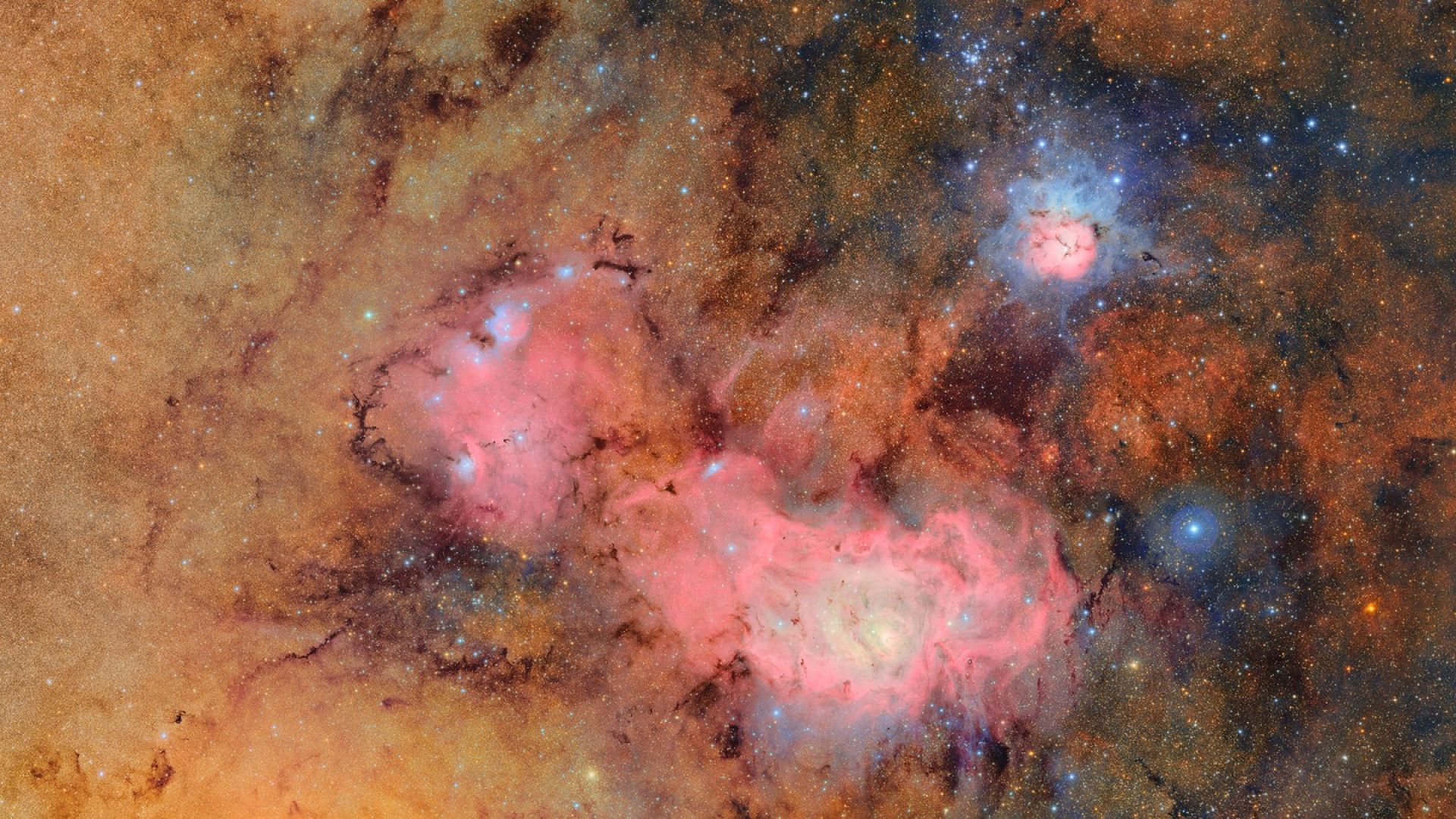
Perched atop Cerro Pachón in Chile’s Atacama Desert, the Vera C. Rubin Observatory is one of humanity’s most ambitious astronomical projects. At 9,000 feet above sea level, in an environment chosen for its isolation, altitude, and atmosphere, the observatory is built to capture the faintest light from the most distant celestial objects. Today, it released its first official images—a moment called “first light”—marking a major milestone in a decades-long global effort involving scientists, engineers, artists, and support staff.
Rubin is a survey telescope designed not just to observe the skies but to systematically map them. Over 10 years, it will catalog 37 billion astronomical objects, revisiting each every three nights to create a dynamic, four-dimensional map of the cosmos. The scale of this effort requires a massive data pipeline, linking the observatory to the SLAC National Accelerator Laboratory in California, where the data is processed into roughly 10 million nightly alerts. These will guide other observatories to transient phenomena like supernovas and interstellar visitors—and potentially even help detect threats like near-Earth asteroids or evidence of alien life.
Rubin’s core is an optical telescope, visually aligned with human perception. Yet its technological sophistication is staggering: it houses three giant mirrors balanced with extreme precision and a 3.2-gigapixel camera—the world’s largest. These mirrors, polished to near-perfection, must continuously autocorrect for minute distortions caused by gravity. Each image captures light that has traveled billions of years, representing a synthesis of material engineering, computation, and celestial wonder.
For the observatory’s artist in residence, Rubin is not just a machine, but a sculptural, almost sacred object—a modern mountaintop cathedral built to extend ancient rituals of sky-watching. As dusk falls and the observatory’s glass, steel, and silicon begin their nocturnal dance, it becomes clear that Rubin is more than a scientific tool. It’s a planetary monument, translating the invisible light of the cosmos into shared human insight. In this way, it embodies a profound continuity: each bolt, weld, and pixel part of an unbroken lineage of cosmic curiosity stretching back to the first humans who gazed upward.
